

Queen Cleopatra
Click Here for a Printable Copy: Queen Cleopatra – Biography
ABOUT Cleopatra
The Egyptian queen that is widely known by “Cleopatra” alone was Cleopatra VII Philopator.
Cleopatra ruled over a diverse kingdom that extended from Asia Minor to the interior of Egypt. She was also a naval commander who led her own fleet in battle and a scholar who supported the arts. She was a charming person with a commanding presence. She was skilled in horseback riding and hunting.
Throughout her life, Cleopatra had to deal with Rome constantly interfering in her family’s rule in Egypt and had to find ways to creatively and carefully build a relationship with Rome that did not result in Rome taking over Egypt. This was ultimately unsuccessful though, as after her death, Egypt became a province of the Roman Empire.
The Myth Versus the History:
Myths of Cleopatra tend to focus on her love affairs with powerful men like Julius Caesar and Marcus Antonius. However, historians have noted that these relationships were careful political decisions that helped her give birth to successors to maintain her dynasty – the Ptolemaic Dynasty – in Egypt. Even though she was ultimately unsuccessful in keeping the Ptolemaic dynasty in power, she must be recognized for the skilled ruler that she was.
About the Ptolemaic Dynasty:
Cleopatra was the last ruler of the Ptolemaic Kingdom of Egypt, a kingdom established by the descendants of Alexander the Great of Macedonia.
By the time Cleopatra came to the throne, she had inherited a dynasty that was in turmoil and in trouble. Under her father, Ptolemy XII, the people of Egypt were unhappy with the government and faced economic decline. Her father had asked Rome for help in managing discontent in Egypt. His oldest daughter, Berenike IV, Cleopatra’s older sister, had seized the throne while their father was in Rome. However, her father had her executed when he returned because he wanted the throne back. Cleopatra took the throne after her father died.
About Cleopatra’s Reign:
When Cleopatra first took the throne, she ruled jointly with her younger brother, Ptolemy XIII, because there was some opposition to a woman ruling alone. A civil war actually broke out between supporters of Cleopatra and her brother, which Cleopatra won. In order to defeat her brother, Cleopatra started a romantic and political relationship with Gaius Julius Caesar (the person known famously today as “the” Julius Caesar). Caesar helped Cleopatra win the war, and her brother, Ptolemy XIII, was killed. She soon gave birth to a son, who she named Caesarion, and claimed that Julius Caesar was the boy’s father.
In the years after the civil war, Cleopatra worked towards rebuilding and stabilizing her kingdom. She paid off her father’s debts and fixed long-standing economic problems. However, because she, like her father, had now gotten deeply involved in Roman politics and had received help from them, she had to work to protect Egypt from being taken over by Rome.
In 46 BC and 44 BC, she travelled to Rome to assert her position in the Roman political scene. While she was there in 44 BC, Julius Caesar was assassinated, and she tried to have her son, Caesarion, accepted as Caesar’s heir.
This was unsuccessful, and tensions in Rome between those who assassinated Caesar and wanted to avenge his death came into conflict.
About Cleopatra and Marcus Antonius (Mark Antony):
While this conflict was raging on, Cleopatra and Marcus Antonius formed a political and romantic relationship in order to create some stability in her Kingdom of Egypt. Marcus Antonius worked with Cleopatra to restore her Ptolemaic Kingdom and expand its borders into the Levant, Asia Minor, and towards the Aegean Sea (basically, modern-day Middle East).
Cleopatra and Marcus Antonius ended up having twin boys together, but Marcus Antonius left Cleopatra, went back to Italy, and married another woman named Octavia.
In the meantime, Cleopatra continued to rule her kingdom and raise her children. Marcus Antonius returned to Egypt and continued helping Cleopatra enhance her territory. They took territory away from King Herod (the same one from the bible’s nativity story). One of the expeditions they went on together, the Parthian expedition, was a failure. After this expedition, Marcus Antonius did not return to Rome. Instead, he returned to Alexandria with Cleopatra.
They became officially married, and their children were designated rulers in Cleopatra’s kingdom. This did not make rulers in Rome happy, and they started sending propaganda that aimed to discount the sovereignty of Cleopatra’s children. They also tried to direct Roman prejudices against Cleopatra and her children by framing her as a barbarian woman. Many of the popular stories and xenophobic myths that frame Cleopatra as a promiscuous, “exotic,” and incompetent woman and foreigner come from this propaganda campaign.
Invasion from Rome and Cleopatra’s Death:
A Roman ruler named Octavian declared war against Cleopatra in 32 BC. Cleopatra commanded a fleet and defended some of her territory on the west coast of Greece against Octavian’s attacks. She went back to Egypt to defend it from Octavian’s invasion. She knew that she had few options left to protect herself and her family from Roman attack. She tried to flee to India and put her son, Caesarion, on the throne.
Octavian then invaded Egypt in 30 BC. Cleopatra tricked Marcus Antonius into committing suicide. She saw that there was likely going to be no way out of the invasion and that her rule and dynasty was coming to an end. In order to stop herself from being captured by Octavian and humiliated in Rome, she killed herself.
Additional Readings
Duane W. Roller. Cleopatra: A Biography. Oxford: Oxford University Press, 2010.
*The introductory chapter had a lot of helpful information and research.
Might be accessible for young kids.
Another video which might be accessible for young kids.
Video which might be more accessible for young kids. They centre her and avoid some of the sexist and orientalist assumptions which dominate popular myths about her life.
.jpg/960px-Retrato_femenino_(26771127162).jpg)
Image of Cleopatra from 1st century AD

Cleopatra dressed as a pharaoh presenting offerings to the goddess Isis dated 51 BC

Cleopatra dressed as a pharaoh presenting offerings to the goddess Isis

Coin depicting cleopatra which were found in Syria

A painting of cleopatra which was found in Italy
Queen Nefertiti
Queen Amina
Click Here for a Printable Copy: Queen Amina – Biography
ABOUT Queen Amina
Amina of Zaria, commonly known as the warrior Queen, expanded the territory of the Hausa people of North Africa to the largest borders in its history. She was the warrior Queen of Zazzau (now called Zaria). She is also known as Amina Sarauniya Zazzau. She was the 24th habe (name for rulers of Zazzau).
According to most accounts, Amina ruled for thirty-four years, from 1576 to 1610. Her domain of Zazzau, a city-state of Hausaland, was eventually renamed Zaria and is the capital of the present-day emirate of Kaduna in Nigeria.
Amina’s family:
She was the oldest of three royal siblings, and was sixteen years old when her noble parent, the powerful Bakwa of Turunka, inherited the throne of Zazzau. It’s unclear whether Bakwa was her father or mother. The reign of Bakwa in Zazzau was known for its peace and prosperity. She had a younger brother named Karama and a younger sister named Zaria.
About Zazzau:
Zazzau was a smaller state that sat at the borders of other larger warring states, and was occupied by the Fulani and at others by the Hausa. Throughout Hausaland, the years AD 1200-1700 were years when warfare and military campaigns for the purpose of increasing commerce were common. Warfare during this period tended to be carried out in an effort to control trade and expand the Hausa communities. Often, the polities that the Hausa fought against, such as the Mali, Fulani, and Bornu, fought back in these clashes as aggressors.
This is the context in which Amina came of age as a teenager, where she herself honed her battle skills under the guidance of soldiers in the Zazzau military.
The citizens of Hausaland displayed advanced skills in the industrial arts of tanning, weaving, and metalworking. in contrast, agriculture was the dominant activity in the areas surrounding Hausaland.
Amina’s Reign:
Upon the death of Bakwa in 1566, Amina’s brother, Karama, became the ruler of Zazzau. Although Karama was younger than Amina, the throne went to the son first. Ten years later, Karama died, and Amina took the throne. She had matured into a fierce warrior and had earned the respect of the Zazzau military. She had established her dominance as the head of the Zazzau cavalry even before she came to rule Zazzau.
The reign of Amina occurred at a time when the city-state of Zazzau was situated at the crossroad of three major trade corridors of northern Africa, connecting the region of the Sahara with the remote markets of the southern forest lands and western Sudan. It was the rise and fall of the powerful Songhai (Songhay) people and the resulting competition for control of trade routes that incited continual warring among the Hausa people and the neighbouring settlements during the fifteenth and sixteenth centuries. It was not until later that a ruling arrangement between the Hausa and the Fulani people ultimately 1brought lasting peace into the region and survived into the colonial era of the nineteenth century.
Within three months of inheriting the throne, Queen Amina embarked on what was to be an ongoing series of military engagements. She stood in command of an immense military band and personally led the cavalry of Zazzau through an ongoing series of campaigns, waging battle continually throughout the course of her sovereignty.
Most of her time in power was spent carrying out military campaigns that were meant to ensure safe passage for Zazzau and other Hausa traders throughout the Saharan region. Amina’s strategy was to significantly expand the borders of Zazzau territory. Under her rule, they were the largest they would ever be in Zazzau’s history. At one point, under Amina’s rule, the Zazzau’s borders covered trade routes connecting eastern Sudan with Egypt in the east and Mali in the north. Amina also built walls around the encampments of the territories that she conquered. Some of these walls survive to this day.
Some historians credit Amina with introducing protective armour (like iron helmets and chain mail) to the Hausaland military. Under her rule, the Hausa of Zazzau were well skilled in the metalworking crafts. Some historians also credit Amina with originating the Hausa practice of building military encampments behind fortress walls. A 15 km wall surrounding the modern-day city of Zaria dates back to Amina’s rule and is known as Amina’s wall.
It is believed that Amina died during a military campaign at Atagara, near Bida in Nigeria.
Disputed elements:
Many details of her life remain in dispute among historians. She is presumed to have been a Muslim ruler. Information about her life mainly comes from the Kano Chronicles (transcribed Hausa writings and oral traditions of Nigeria).
Some accounts of Amina date her rule back from 1421-1438.
ADDITIONAL READING:
“Amina of Zaria.” In Encyclopedia of World Biography, 2nd ed., 5-7. Vol. 21. Detroit, MI: Gale, 2004. Gale eBooks (accessed December 30, 2020).
The video might be accessible to old kids.
This video goes through her early life, her impact on Hause architecture, and highlights how her military campaigns were mainly about expanding trade route for her people.
This video goes into even more detail about Zazzau, where Amina was from.

Statue of Queen Amina at the National Arts Theatre in Lagos, Nigeria. This blog post contains some images of her depicted on Nigerian stamps and artwork.

Gates to the palace of the emir of Zazzau:
Amanirenas
Queen Sheba
Click Here for a Printable Copy: Queen of Sheba – Biography
Queen of Sheba
The Queen of Sheba was also known as Queen Makeda of Sheba (in Ethiopian accounts) and Bilqis (in the Quran). In Ethiopia, she is recognized as the mother of King Menelik I, who would become the first king of the Solomonic Dynasty in Ethiopia. The Solomonic Dynasty was abolished in 1997 with the death of Amha Selassie. His heir, Crown Prince Zera Yacob, is today recognized as the head of the Ethiopian Royal family, but is not a ruling monarch. Some Ethiopians believe that it was through the Queen of Sheba that Christianity came to Ethiopia.[1]
Historians debate whether the Queen of Sheba came from the Kingdom of Axum in Ethiopia or the Kingdom of Saba in Yemen or both. [2] Islamic and Jewish traditions agree that Queen Makeda of Sheba flourished in the 10th century BC. In the 10th century BC, she visited King Solomon, King of Israel and descendant of David. [3]
In all three ancient accounts of her life, she is described as beautiful, intelligent, and wealthy. She was a powerful monarch in the ancient world. It was through her meeting with King Solomon that she began worshipping the God of Abrahamic faiths. [4]
Significance in Twentieth-Century History:
Haile Selassie, who lived from 1892-1975, was a descendant of the Queen of Sheba and fought to defend Ethiopia from Italian invasion. He adhered to the Ethiopian Orthodox Church. During Italy’s occupation of Ethiopia, he spent his exile in England and returned to lead Ethiopia in 1941 after the British defeated Italian occupiers during the East Africa campaign, a military effort which took place during WWII. Haile Selassie presided over the Organisation of African Unity (OAU) in 1963. The OAU, which existed until 2002, aimed to encourage the political and economic integration of member states on the African continent and eradicate colonialism and neo-colonialism.
Significance to the Rastafari Movement:
The Rastafari movement was founded in Jamaica during the 1930s. In this religious and social movement, Haile Selassie is referred to as the Second Coming of Jesus, and Jah (God) incarnate. Afro-Jamaican communities mobilized the Rastafari movement as a form of resistance against white supremacy and British colonial rule.
[1] https://www.britannica.com/biography/Queen-of-Sheba
https://www.pbs.org/mythsandheroes/myths_four_sheba.html
[3] Shelley P. Haley, “Makeda, Queen of Sheba.” The Oxford Encyclopedia Women in World History. Oxford University Press. 2008. Edited by Bonnie G. Smith.eISBN:9780195337860
[4] Shelley P. Haley, “Makeda, Queen of Sheba.” The Oxford Encyclopedia Women in World History. Oxford University Press. 2008. Edited by Bonnie G. Smith.eISBN:9780195337860
Appreciate for kids
Might be for older kids who can read
Reading a story about the Queen of Sheba for younger children which address the fact that she was likely from Ethiopia or Yemen
Reading a story about the Queen of Sheba for younger children which address the fact that she was likely from Ethiopia or Yemen

Depiction of sheba on the walls of an 11th century Ethiopian Church, built by king Lalibela

Image of bilqis(Queen of Sheba) from the Quran in Persian miniature style
Lalibela - The African King
Click Here: Printable Copy: King Lalibela Biography
ABOUT Lalibela – the African King
The churches of Lalibela are a set of eleven exquisite medieval cave churches built in 12th-century Ethiopia. They still stand today and serve as a place of pilgrimage. The churches were carved out of rock.
About the site of Lalibela, now a UNESCO world heritage site: https://whc.unesco.org/en/list/18/
They were built under the leadership of the King of Lalibela of the Zagwe dynasty in Ethiopia in the 12th century. Lalibela (previously named Roha) was the administrative capital of the Zagwe Empire. Lalibela was the best-known Zagwe emperor, and the capital eventually was renamed after him.
Some information on the Zagwe empire: https://www.britannica.com/topic/Zagwe-dynasty#ref184295
The Gadla Lalibela is a book that dates back to the 14th century and offers some information about Lalibela’s life. There are, however, slightly different versions of this story which are passed down in different oral, artistic, and written traditions in Ethiopia.
Lalibela’s father was named Jan Seyoum. His brother, King Herbay, was on the throne and heard a prophecy that his brother, Lalibela, would one day wear the crown. He was worried about Lalibela taking the throne from him. Lalibela’s half-sister also did not want him to take the throne and sent him some poisoned beer.
Lalibela asked the bearer of the beer to taste it for him, and the bearer died from the poison. Shocked that he was responsible for the bearer’s death, Lalibela drank the poison as well. Lalibela felt weak and collapsed. While he was being prepared for burial, the undertakers found that his body was still warm. Lalibela claimed that he went on a visit to all seven heavens on Saint Gabriel’s wings, where God showed him ten rock-hewn churches. God told Lalibela not to be afraid of becoming king, because it was his duty to create churches on earth like those he had shown him in Heaven. After three days and three nights, Lalibela returned to earth and his soul re-entered his body, at which time he made a pact with God to create the churches that he had commanded Lalibela to excavate. The people who had been preparing Lalibela’s body for burial were amazed and spoke of it as a miracle, like Jesus’s rise from the dead. However, Lalibela continued to be persecuted by hostile members of his family. Distressed by their bullying, Lalibela fled to the desert, declaring it better to live among wild animals than among men. While he was living in a cafe, he was comforted by Saint Rufael. Shortly after, an angel appeared and declared that the next day, a young woman would be seen who was destined to be his wife. Sure enough, a woman named Masqal Kebre arrived searching for herbs. Lalibela and Masqal Kebre lived together, and her parents blessed their union.
All the while, King Herbay was searching for Lalibela. Herbay found Lalibela and ordered him and his wife to separate and told Lalibela to visit Jerusalem with Saint Gabriel. Lalibela visited Jerusalem and prayed at the Holy sepulchre and returned to Ethiopia and reunited with his wife, Masqal Kebre. Jesus came to King Herbay in his dreams and condemned him for how he treated Lalibela and told him that Lalibela should take on the throne and live to build churches without stones or mortar.
Lalibela then took the throne and created, by God’s command, the rock-hewn churches modelled on those he saw in Heaven. He paid the workers all that they demanded as wages, without any exploitation, and they were assisted by unseen angels who toiled on the work in the night.
Shortly after the churches were completed, Lalibela died after a short illness. He did not want his son to succeed him because Lalibela favoured the restoration of the Israelite or Solomonic dynasty.
UNESCO’s video about Lalibela’s churches. It talks a bit about Lalibela’s story:
Smithsonian’s YouTube channel – video on Lalibela’s churches and its connections to Judaism:
Longer video for teachers for some more information about the Lalibela site and its protection today: https://www.cbsnews.com/news/lalibela-rock-cut-churches-christmas-eve-60-minutes-2020-12-20/

The end of this article contains snapshots of some images that depict Lalibela’s life story: https://www.persee.fr/docAsPDF/ethio_0066-2127_2006_num_22_1_1481.pdf
Mansa Musa
Click Here for a Printable Copy: Mansa Musa – Biography
ABOUT Mansa Musa
Mansa Musa was the emperor of Mali from approximately 1307 to 1332. He was widely known for his wealth, for his pilgrimage to Mecca in 1324, and for building the great mosque at Timbuktu. He was the grand-nephew of Sundiata, another powerful African king who founded their dynasty in Mali.
About Mansa Musa’s pilgrimage to Mecca:
Mansa Musa’s pilgrimage to Mecca was what brought global attention to Mali and its wealth. During his pilgrimage, he stopped in Cairo and in Mecca. He began his pilgrimage in his capital of Niani, on the upper Niger River, to Mauritania, Algeria, and eventually to Cairo and Mecca.
Mansa Musa was accompanied by a caravan of 60,000 men, including 12,000 slaves wearing brocade and Persian silk. He rode on horseback and was preceded by 500 slaves each carrying a gold-adorned staff. He also had a baggage train of 80 camels, each carrying 300 pounds of gold.
Mansa Musa came to be known for his generosity and made a favourable impression where he travelled. He spent so much gold in the Cairo market when he visited that he caused inflation.
Although other rulers of West African states had made pilgrimages to Mecca before Mansa Musa, Mansa Musa’s pilgrimage was famous because it was so extravagant.
About Timbuktu:
While Mansa Musa was on his pilgrimage, one of his generals, Sagmandia, extended the empire of Mali by capturing the capital of the neighbouring Songhai kingdom. When he returned from his pilgrimage, Mansa Musa commissioned many projects that built up the
city of Timbuktu and made it renowned globally as an intellectual, religious, and trade centre.
Mansa Musa commissioned a poet and architect from Granada to build mosques in Timbuktu and Gao (former Songhai kingdom capital).
Under Mansa Musa, Timbuktu grew into an important commercial city that crossed trade routes connecting to Egypt and other important trade centres in North Africa.
Sankore University:
Mansa Musa founded the ancient university of Sankore in Timbuktu (also called the Sankore Madrasa/Madrash). There, students and scholars could learn and exchange ideas about history, Quranic theology, and law.
The “University of Sankore” was very different in organization from the universities of medieval Europe. It had no central administration, student registrars, or prescribed courses of study. It was composed of several entirely independent schools or colleges, each run by a single master or imam. Students associated themselves with a single teacher, and courses took place in the open courtyards of mosque comple1xes or private residences. The primary focus of these schools was the teaching of the Quran, although broader instruction in fields such as logic, astronomy, and history also took place. The imams who taught at the Sankore mosque were respected. [1]
ADDITIONAL READINGS
This article is not about Mansa Musa specifically, but it helps to address the assumption that there were no literary cultures on the African continent. Mansa Musa’s library also directly challenges this assumption, as does the library at Alexandria.
https://www.bu.edu/africa/outreach/teachingresources/history/k_o_mali/
[1] https://www.pbs.org/wonders/Episodes/Epi5/5_wondr6.htm
Resource created by the Boston University Pardee School of Global Studies African Studies Centre. Contains Kingdom of Mali Primary Source Document excerpts and other teacher resources. The excerpt linked here is an account from people in Cairo meeting Mansa Musa when he passed through there in 1324.
This video is suitable for very young kids and contains a lot of good information about Mansa Musa.
Shorter video for older kids with more complicated concepts like “inflation” and “economy”
Illustrate and accessible TED Talk about Mansa Musa’s life and importance
Crash Course Youtube channel’s video on Mansa Musa. Might be better for old kids. Address some of the assumptions society makes about histories captured through oral traditions. Interesting points about Mansa Musa’s awareness of the world beyond the African continent.
Beautifully illustrated video about the importance of the library at Timbuktu – built by Mansa Musa. Better for older kids. More about what happened after Mansa Musa’s death and the Songhai empire. Interesting discussion of what was going on at the Sankore university. Goes up to the present day and the resilience of Timbuktu’s people to preserve their scholarly history and ancient books.
“Draw my Life” version of Mansa Musa. Has more detail about how Mansa Musa came to the throne, as well as some discussion of the Mali Empire’s exploration of the Atlantic ocean by boat.
Some helpful information about Timbuktu’s importance in the Trans-Saharan, but focuses on what was going on in other parts of the African continent during Mansa Musa’s lifetime.
https://en.wikipedia.org/wiki/Mansa_Musa#/media/File:Catalan_Atlas_BNF_Sheet_6_Mansa_Musa.jpg
The Catalan Atlas, a 14th-century medieval European map (created 1375), depicts Mansa Musa, Mali, and Timbuktu as a principal point along the trans-Saharan trade routes in West and North Africa. The Catalan Atlas is important because it demonstrates how societies from outside the African continent knew about prominent African rulers, and even depicted them in their scholarly works.

Genealogy of the Mali Empire Kings
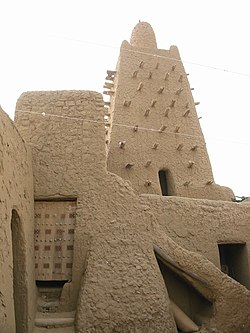
Djingareyber Mosque, which was commissioned by Mansa Musa and still stands today.
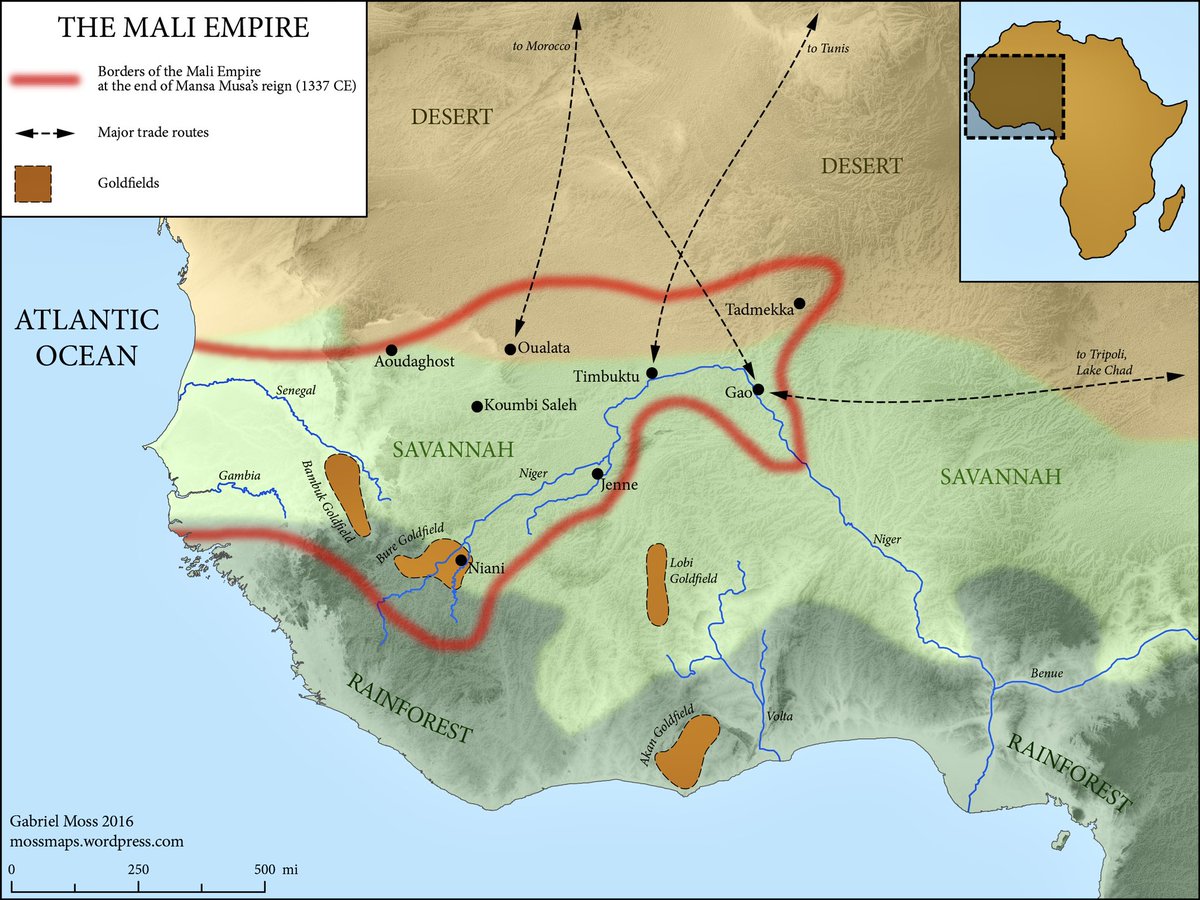
Map of the Mali Empire under Mansa Musa

Mosque from the Empire of Mali. Date of Construction Unknown.
Shamba Bolongongo
Click Here for a Printable Copy: Shamba – Biography
ABOUT Shamba Bolongongo
Shamba Bolongongo is also called Shyaam aMbul or King Shyaam aMbul aNgoong. He was known as “The King of Peace.”
He was a King who reigned over the Bushongo people in about AD 1600, and was the 93rd King of the Kuba Kingdom, which still exists today.
Shamba’s Early Life:
Shamba was interested in engaging with foreigners beyond Bushongo’s borders. When he was nineteen years old and still a prince, he requested permission from the King and Queen to travel beyond the borders of the Bushongo kingdom. The King and Queen were wary of this because travel was considered dangerous – there were wild beasts and other societies who might be hostile to Bushongo peoples.
But Prince Shamba was persistent and had a strong desire to learn about the places beyond Bushongo borders, so the King and Queen let him go. Accompanied by a large entourage of aides, servants, and warriors, he went on a two-year tour to build knowledge that would make him a better, wiser ruler.
By the time he returned to Bushongo land, the King had died, and Shamba ascended to the throne.
Shamba Bolongongo’s Reign:
During Shamba’s rule, he introduced many significant changes to his people. He taught them to weave raffia fibre into cloth and cultivate cassava (which helped keep locusts away from important crops, like maize and millet).
Shamba made sure that fourteen women held official positions in the government. He also brought the art of embroidery and encouraged other forms of arts and crafts under his rule. He also brought the game mancala to Bushongo.[1] He made sure that crafts and industries had a voice in the government. Representatives from eighteen trades had a voice in the government: wood-sculptors, weavers, blacksmiths, leather workers, singers, dancers, musicians, fishermen, hunters, boat makers, oil manufacturers, mat makers, salt processors, tailors, rope makers, hoosiers, and spinners of thread.
During his reign, King Shamba tried to bring peace to his kingdom. He tried to abolish war, restricted his armed forces to police duty, and eliminated the use of bows and arrows. He ordered that the State knife be replaced with a wooden blade for ceremonies.
The Bushongo kingdom became known and respected under Shamba, and his subjects were able to travel freely in neighbouring kingdoms as traders.
If a subject was killed in a distant village, the Bushongo did confront the aggressors but did not kill anyone in retaliation for the death.
About Bushongo:
Bushongo, or Kuba Kingdom, was a society situated in Central Africa. It is in the southeast of modern-day Democratic Republic of the Congo. The Bushongo were a Bantu-speaking federation of seventeen tribes living along the Kasai and Sankuru rivers of the Congo. They founded a nation together. Officially appointed historians of the Bushongo kingdom kept an account of 121 dynasties, going back to the 5th-century AD. Bushongo’s third ruler was a woman named Lobamba who ruled in about AD 490.
ADDITIONAL READINGS
All about Ndop sculptures that King Shamba founded.
[1] https://en.wikipedia.org/wiki/Mancala
https://scholar.harvard.edu/files/nunn/files/kuba_paper_september_2016.pdf
Sections of this paper discuss Shyam (Shamba) and the Kuba Kingdom.
https://www.britannica.com/biography/Shamba-Bolongongo
Morris Siegel. “Shamba Bolongongo: African King of Peace.” https://www.sahistory.org.za/sites/default/files/archive-files2/asapr58.18.pdf
This video might be accessible to older kids. She talks about Sham (Shamba) and explains the founding of the Kuba kingdom and Kuba society clearly.
For teachers – about Kuba art with the current Kuba Prince
On Kuba textiles at DC textile musuem
.jpg/1200px-Brooklyn_Museum_61.33_Ndop_Portrait_of_King_Mishe_miShyaang_maMbul_(5).jpg)
https://www.metmuseum.org/toah/hd/kuba/hd_kuba.htm
Contains images of artifacts that represent Bolongongo and other examples of Kuba Kingdom Art.
https://www.artic.edu/artists/97811/bushongo
Bushongo art at the Art Institute of Chicago.
https://www.housebeautiful.com/design-inspiration/a34304694/what-is-kuba-cloth/
Kuba Kingdom raffia fabric, which Shamba brought to the kingdom.
Taharqa
Click Here for a Printable Copy: King Taharqa – Biography
ABOUT Taharqa
Taharqa was the son of Piye, the Nubian king of Napata who had first conquered Egypt. Taharqa was also the cousin and successor of Shebitku.[6] The successful campaigns of Piye and Shabaka paved the way for a prosperous reign by Taharqa.
King Taharqa, also called Tirhaka, reigned Egypt from 690 to 664 BC. His cousin, Sheibitku, held the throne before him. During his reign, Taharqa gave military support to resistance movements against Sennacherib, the King of Assyria.[1]
When he reigned over Egypt, his territory stretched from Sudan to the Levant. Taharqa came from the 25th dynasty of Egypt, which was a dynasty of Pharaohs from Nubia. This meant that the Pharaohs of this dynasty all originated from modern-day Sudan. These Pharaohs brought some elements of Egyptian culture into Sudan, such as pyramids. Taharqa was the final ruler of his dynasty.[2]
Taharqa’s Conflicts with the Assyrian Empire:
Eventually, Taharqua was defeated by Sennacherib’s son, Esarhaddon, who ended up capturing the city of Memphis in Egypt. Meanwhile, Esarhaddon set up a new kingdom in Assyria, which consisted of a government that collected tribute from surrounding chiefs in the area.
During this time, Taharqa took refuge in Upper Egypt. When Sennacherib’s son withdrew from Egypt, Taharqa returned to Egypt and defeated Esarhaddon’s forces in Assyria, regaining control of Egypt.
However, Taharqa had to flee Egypt again when Esarhaddon’s son, Ashurbanipal, defeated him. Taharqa fled to Nubia where he lived the rest of his days.[3]
ADDITIONAL READINGS
Owen Jarus. “Massive statue of Pharaoh Taharqa discovered deep in Sudan.” Independent. Friday January 8, 2010. https://www.independent.co.uk/news/world/africa/massive-statue-pharaoh-taharqa-discovered-deep-sudan-1862007.html
[1] https://en.wikipedia.org/wiki/Taharqa#Early_life
https://www.britannica.com/biography/Taharqa
[2] Owen Jarus. “Massive statue of Pharaoh Taharqa discovered deep in Sudan.” Independent. Friday January 8, 2010. https://www.independent.co.uk/news/world/africa/massive-statue-pharaoh-taharqa-discovered-deep-sudan-1862007.html
[3] https://www.britannica.com/biography/Taharqa
https://www.cnn.com/videos/world/2018/05/25/inside-africa-taharqa-nubia-dynasty-sudan-pyramid-b.cnn
About the pyramid in Sudan where Taharqa was buried.
Contains images of a massive stone statue of Taharqa, which was found in 2010.
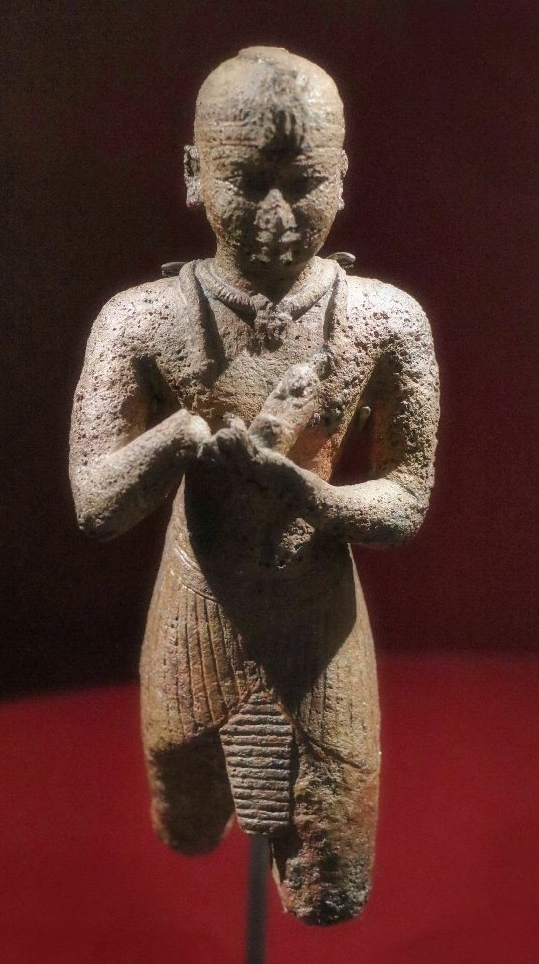
https://collections.rom.on.ca/objects/188797/shabti-of-king-taharqa
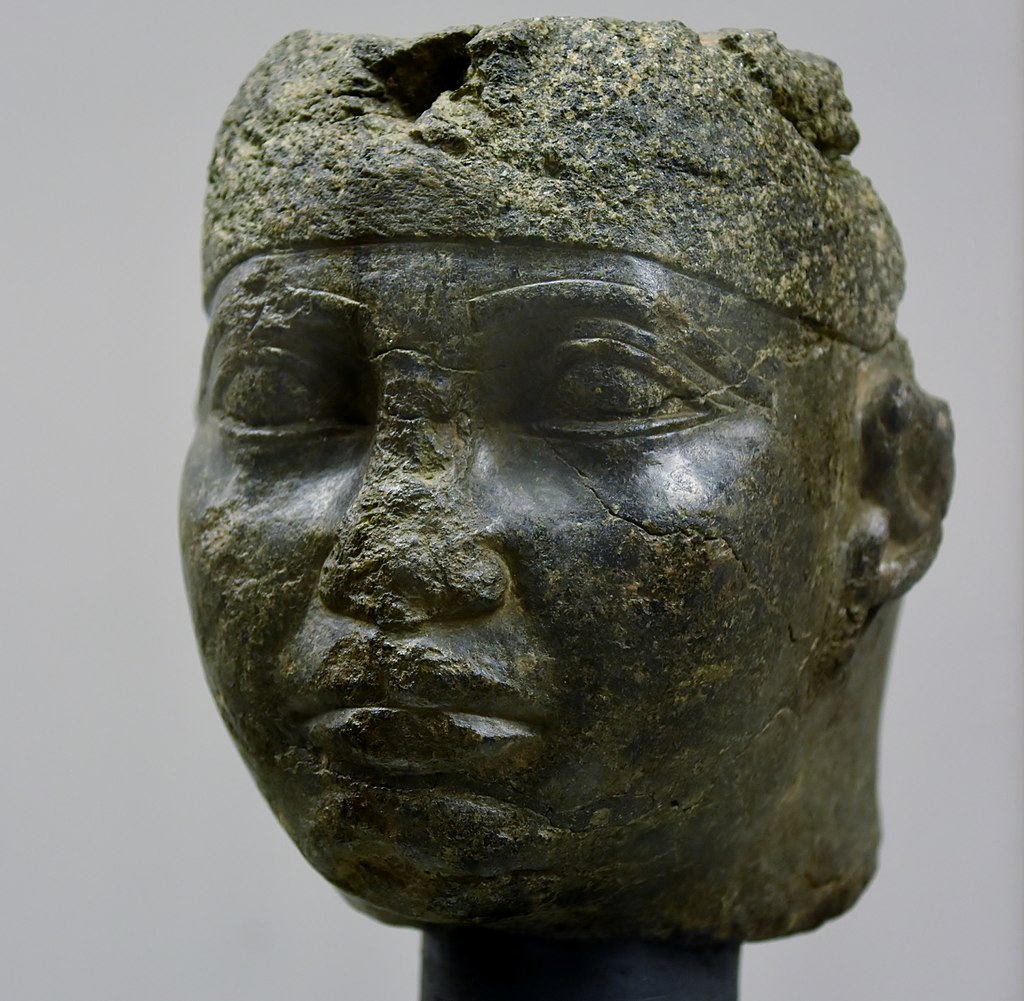
Statue of Taharqa displayed at the Royal Ontario Museum. It was a gift from the Government of Sudan.
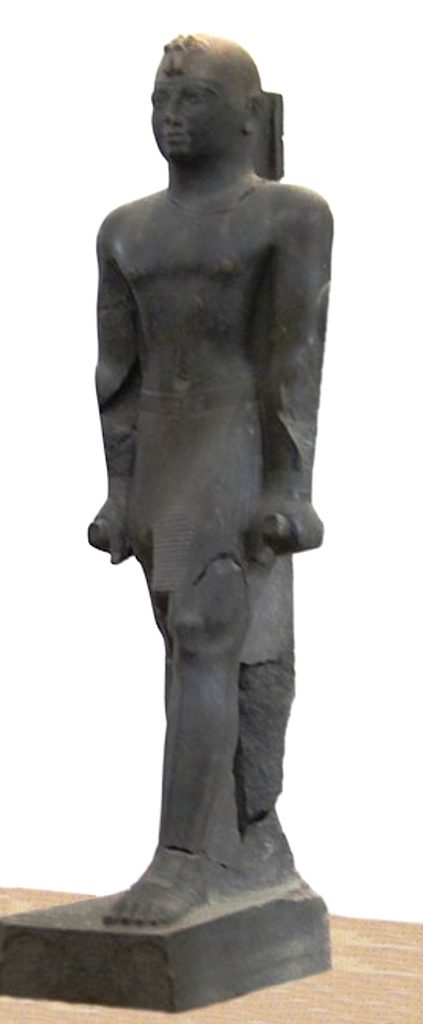
https://www.brooklynmuseum.org/opencollection/objects/49165
Images of Taharqa at the Brooklyn Museum
Tutankhamun
Click Here for a Printable Copy: King Tut – Biography
ABOUT Tutankhamun
The king popularly known as “King Tut” was a pharaoh named Tutankhamun, who reigned from 1361–1352 BC and reigned from 1355–1346 BC in Egypt. He brought polytheism back to Egypt. The discovery of his tomb in 1922 made him an important figure in twentieth-century popular culture and renewed global interest in ancient Egypt.
Tutankhamun was born at Amarna, the city that his grandparents, Nefertiti and Akhenaten, built. His was first named Tutankhaten, a name which means “living images of the sun god, Aten.”
He was very young when he took the throne and was a teenager when he died. He is especially famous because his tomb was discovered in 1922. It was this discovery that confirmed that he was very young when he died because many of the things in the tomb, which were tailored for him, were very small.
Much of Tutankhamun’s short reign was spent re-establishing the older version of Egyptian religious practices and tradition that his grandparents had tried to replace when they created Amarna and introduced Aten, the sun god, as the most important god.
During his reign, Tutankhamun moved the capital of the Egyptian kingdom from Amarna to Memphis (near modern Cairo). There, he refurbished and rebuilt the temples that were neglected during his grandparents’ and parents’ reign.
He engaged in military action in Syria[1] and with the Nubian Kingdom. It is not clear why he died so young, though a wound on his skull behind his ear led some historians to conclude that he was murdered.
Research on Tutankhamun’s Tomb and Remains:[2]
[1] “Tutankhamun” in Who’s Who in Ancient Egypt. Routledge, 2003.
[2] https://www.britannica.com/biography/Tutankhamun
In 2010, scientists found traces of malaria parasites in his mummified remains, which indicated that malaria and a degenerative bone disease might have caused his early death. He was about nineteen years old.
He died without designating an heir and was succeeded by a ruler named Ay.
Tutankhamun is significant because his tomb, when found in 1922, was mostly intact and provided some idea about ancient Egyptian burial practices. His tomb contained his mummified body resting within three nested coffins, one which was solid gold, and two others that had gold hammered over wooden frames. The other rooms of his tomb contained furniture, clothes, chariots, and weapons which would take him to the afterlife.
ADDITIONAL READINGS & RESOURCES
Podcast episode from BBC’s In Our Time about the study of Tutankhamun’s tomb and what it tells us about Egyptian history. https://www.bbc.co.uk/programmes/m000cng6
https://www.youtube.com/watch?v=-obKX-mqjXQ
National Geographic documentary on Tutankhamun’s tomb and life.
https://www.youtube.com/watch?v=LwXfvfPy6fc&t=3s
PBS documentary about Tutankhamun.
https://www.youtube.com/watch?v=DKluUdV6ddw
Smithsonian Channel documentary about Tutankhamun. Includes info on the items buried with him, including food and snacks.
https://kingtutexhibition.com/news/tutankhamun-facts-10-things-you-didnt-know-about-tutankhamun/

Photos from the King Tut exhibition in Boston https://kingtutexhibition.com/
Hannibal
Click Here for a Printable Copy: Queen Cleopatra – Biography
ABOUT Cleopatra
The Egyptian queen that is widely known by “Cleopatra” alone was Cleopatra VII Philopator.
Cleopatra ruled over a diverse kingdom that extended from Asia Minor to the interior of Egypt. She was also a naval commander who led her own fleet in battle and a scholar who supported the arts. She was a charming person with a commanding presence. She was skilled in horseback riding and hunting.
Throughout her life, Cleopatra had to deal with Rome constantly interfering in her family’s rule in Egypt and had to find ways to creatively and carefully build a relationship with Rome that did not result in Rome taking over Egypt. This was ultimately unsuccessful though, as after her death, Egypt became a province of the Roman Empire.
The Myth Versus the History:
Myths of Cleopatra tend to focus on her love affairs with powerful men like Julius Caesar and Marcus Antonius. However, historians have noted that these relationships were careful political decisions that helped her give birth to successors to maintain her dynasty – the Ptolemaic Dynasty – in Egypt. Even though she was ultimately unsuccessful in keeping the Ptolemaic dynasty in power, she must be recognized for the skilled ruler that she was.
About the Ptolemaic Dynasty:
Cleopatra was the last ruler of the Ptolemaic Kingdom of Egypt, a kingdom established by the descendants of Alexander the Great of Macedonia.
By the time Cleopatra came to the throne, she had inherited a dynasty that was in turmoil and in trouble. Under her father, Ptolemy XII, the people of Egypt were unhappy with the government and faced economic decline. Her father had asked Rome for help in managing discontent in Egypt. His oldest daughter, Berenike IV, Cleopatra’s older sister, had seized the throne while their father was in Rome. However, her father had her executed when he returned because he wanted the throne back. Cleopatra took the throne after her father died.
About Cleopatra’s Reign:
When Cleopatra first took the throne, she ruled jointly with her younger brother, Ptolemy XIII, because there was some opposition to a woman ruling alone. A civil war actually broke out between supporters of Cleopatra and her brother, which Cleopatra won. In order to defeat her brother, Cleopatra started a romantic and political relationship with Gaius Julius Caesar (the person known famously today as “the” Julius Caesar). Caesar helped Cleopatra win the war, and her brother, Ptolemy XIII, was killed. She soon gave birth to a son, who she named Caesarion, and claimed that Julius Caesar was the boy’s father.
In the years after the civil war, Cleopatra worked towards rebuilding and stabilizing her kingdom. She paid off her father’s debts and fixed long-standing economic problems. However, because she, like her father, had now gotten deeply involved in Roman politics and had received help from them, she had to work to protect Egypt from being taken over by Rome.
In 46 BC and 44 BC, she travelled to Rome to assert her position in the Roman political scene. While she was there in 44 BC, Julius Caesar was assassinated, and she tried to have her son, Caesarion, accepted as Caesar’s heir.
This was unsuccessful, and tensions in Rome between those who assassinated Caesar and wanted to avenge his death came into conflict.
About Cleopatra and Marcus Antonius (Mark Antony):
While this conflict was raging on, Cleopatra and Marcus Antonius formed a political and romantic relationship in order to create some stability in her Kingdom of Egypt. Marcus Antonius worked with Cleopatra to restore her Ptolemaic Kingdom and expand its borders into the Levant, Asia Minor, and towards the Aegean Sea (basically, modern-day Middle East).
Cleopatra and Marcus Antonius ended up having twin boys together, but Marcus Antonius left Cleopatra, went back to Italy, and married another woman named Octavia.
In the meantime, Cleopatra continued to rule her kingdom and raise her children. Marcus Antonius returned to Egypt and continued helping Cleopatra enhance her territory. They took territory away from King Herod (the same one from the bible’s nativity story). One of the expeditions they went on together, the Parthian expedition, was a failure. After this expedition, Marcus Antonius did not return to Rome. Instead, he returned to Alexandria with Cleopatra.
They became officially married, and their children were designated rulers in Cleopatra’s kingdom. This did not make rulers in Rome happy, and they started sending propaganda that aimed to discount the sovereignty of Cleopatra’s children. They also tried to direct Roman prejudices against Cleopatra and her children by framing her as a barbarian woman. Many of the popular stories and xenophobic myths that frame Cleopatra as a promiscuous, “exotic,” and incompetent woman and foreigner come from this propaganda campaign.
Invasion from Rome and Cleopatra’s Death:
A Roman ruler named Octavian declared war against Cleopatra in 32 BC. Cleopatra commanded a fleet and defended some of her territory on the west coast of Greece against Octavian’s attacks. She went back to Egypt to defend it from Octavian’s invasion. She knew that she had few options left to protect herself and her family from Roman attack. She tried to flee to India and put her son, Caesarion, on the throne.
Octavian then invaded Egypt in 30 BC. Cleopatra tricked Marcus Antonius into committing suicide. She saw that there was likely going to be no way out of the invasion and that her rule and dynasty was coming to an end. In order to stop herself from being captured by Octavian and humiliated in Rome, she killed herself.
Additional Readings
Duane W. Roller. Cleopatra: A Biography. Oxford: Oxford University Press, 2010.
*The introductory chapter had a lot of helpful information and research.
Might be accessible for young kids.
Another video which might be accessible for young kids.
Video which might be more accessible for young kids. They centre her and avoid some of the sexist and orientalist assumptions which dominate popular myths about her life.
Image of Cleopatra from 1st century AD
Cleopatra dressed as a pharaoh presenting offerings to the goddess Isis dated 51 BC
Cleopatra dressed as a pharaoh presenting offerings to the goddess Isis
Coin depicting cleopatra which were found in Syria
A painting of cleopatra which was found in Italy